

Finland's social and health care system is nurse-driven
Comparatively, we have more nurses but fewer doctors than OECD countries on average.
There has been a growing shortage of nurses since 2016, and also other professional groups in the sector have been in short supply for several years now. The COVID-19 pandemic and eliminating the resulting backlog of treatment increased the need for nursing staff.
Statistics, surveys and foresight data show that the demand forsocial welfare and healthcare professionals isstill high. Therefore, the austeritymeasurestargeting nursingstaffin the wellbeing services counties areshort-sightedand could lead to increased costs for society.
For the first time, Finland has more than a million people aged 70 or over
The volume of memory disorders is growing as the population ages. Many older people need primary healthcare and specialised healthcare services, and some also require home care and 24/7 service housing. Some of the services require round-the-clock staffing.
While the demand for services keeps growing in the wellbeing services counties, professionals of social services and healthcare sectors are retiring. According to Keva, it is estimated that about one fourth of nurses (24 per cent, 11,780) and a little less than a third of practical nurses (31 per cent, 15,610) in wellbeing services counties will retire over the next decade.
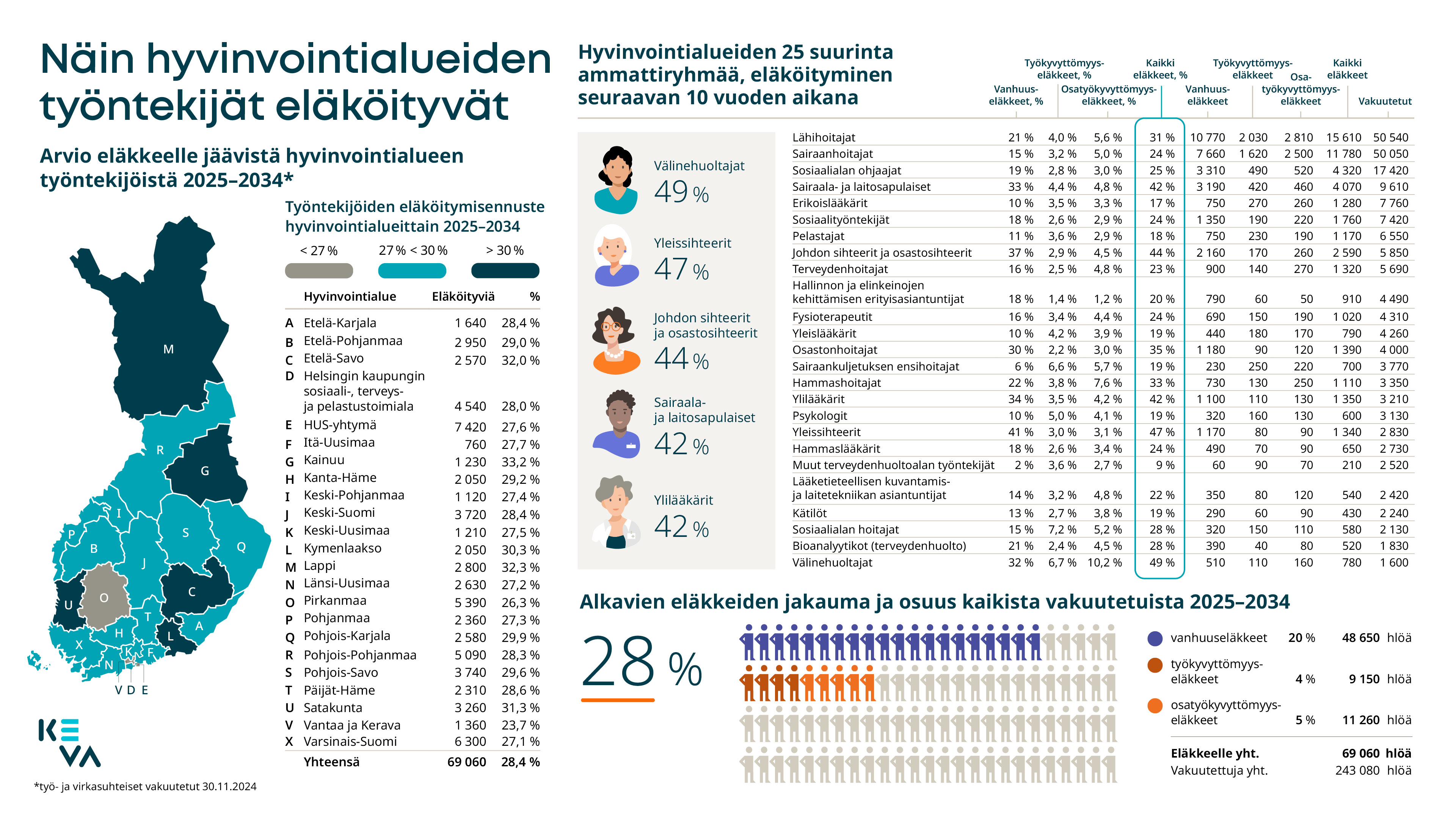
Some nurses and practical nurses are considering a career change, while others have already done so. A survey carried out by the Finnish Institute of Occupational Health and Statistics Finland states that about one in ten (11 per cent) of employed nurses and practical nurses were employed outside the social services and healthcare sector or temporary agency work in 2023. Moving to other sectors has become more common in recent years. Changing jobs has also been common in the field. The government's plans to make fixed-term contracts easier to apply will also make the sector less attractive.
Ageing population and the retirement of health and social care staff to increase the demand for professionals
Juha Honkatukia, Senior Researcher at the Finnish Institute for Health and Welfare, has estimated (see pages 59–63) that between 2021 and 2040 almost 26, 000 more practical nurses and about 9, 400 more nurses will be needed than today.
Staff cuts in wellbeing services counties have led to a situation where people are not getting all the services they need. Almost one in ten (8.6 per cent) Finns reported that they did not have access to the healthcare they needed in 2024, a figure that is clearly well above the OECD average (3.4 per cent).
Poverty in care services for older people is exacerbated by the increasing difficulty of accessing home care and round-the-clock service housing.
How could the nurse shortage be solved?
Funding for wellbeing services counties must be strengthened to enable them to recruit the personnel needed to provide the services. Cuts to the funding of social and healthcare services must be stopped.
Our social services and health care system cannot afford to lose highly educated professionals. The key is to hold onto the nurses working in the sector now. The costs to society will only increase if we have to keep training new nurses to replacethose leaving thesector.
Staff cuts increase the burden on the remaining professionals. Redundancies result in a major loss of competence and expertise accumulated over the years. For example, the skills required in intensive care units and operating theatres cannot be taught to a new employee in a short induction.
Increasing education volumes in social services and healthcare sector is challenging when age groups keep shrinking
While immigration could help ease future labour shortages, it alone will not solve the problem. Skilled social and healthcare staff are internationally competed for and sought after.
According to researchers at the Finnish Institute for Occupational Health, people changing careers provide some labour reserve for the social services and healthcare sector. The circumstances of nurses working outside the sector are varied. Not everyone can be encouraged to return, but it could be possible for some if the working conditions and terms of employment are good enough in the social services and healthcare sector.
Adequate staffing, humane working conditions, clear career paths and fair pay are prerequisites for professionals to want to continue working in the sector.
The next government term should also provide a long-term programme to ensure the availability and retainment of staff in the social services and healthcare sector.
The text was published in Turun Sanomat on 24 February 2026.