
The recession of the early 1990s was a turning point in Finnish economic policy. The recession was steep, the banking crisis was massive, and public finances entered the state of necessity. At that time, the concept of austerity became standard practice: spending was cut, social expenditure was adjusted and wage rises were curbed.This was the time when austerity in practice became more widely established in Finland.
The recession of the 1990s made fiscal austerity a concrete and politically significant concept in Finland. Austerity was also justified by the EU's Stability and Growth Pact, which set limits on public deficits and debt ratios.
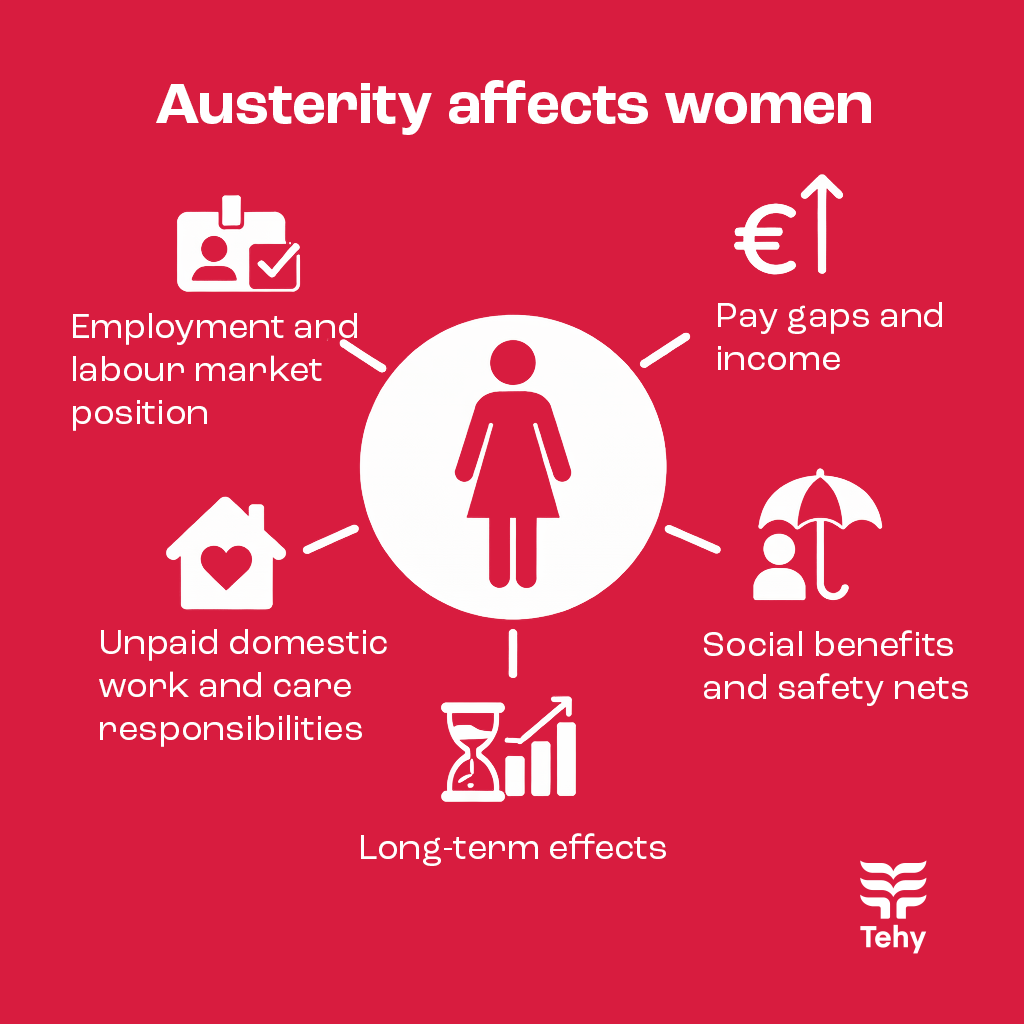
Austerity affects women through various channels, such as employment, wages, social benefits, domestic work and long-term impacts.
How does austerity affect women?
Women make up the majority of workers in the social and health care sector. The financial difficulties in the wellbeing services counties have led to redundancies, which have reduced female employment.
The number of women employed in public administration has fallen by 6,000, and in the sector of ‘other service operations’, including organisations, 9,000 fewer women were employed than a year earlier. In April–June, the number of employee’s in the trade sector was about 20,000 lower than a year earlier.
Contractual wages in wellbeing services counties and municipalities have increased thanks to the increase in contractual wages in the 2022 union negotiation round. It could be said that austerity has luckily not been able to affect the wages in female-dominated sectors, thanks to the agreement system. Purchasing power has been affected by inflation in the 2020s, but falling inflation will have a positive impact on real income.
Cuts compensated with women's work
As a result of the cuts, women are doing more unpaid domestic and care work. According to OECD and EU studies, cuts in public spending increase the amount of domestic work done by women by 10–20% compared to men.
In Finland, studies by the Finnish Confederation of Professionals and the Finnish Institute for Health and Welfare show that women already spend on average 1.5–2 times more time on domestic work than men, and this gap is widening due to austerity. The impacts of this hit single-parent families especially heavily: housework and childcare increase significantly as support services are reduced.
Savings in social and health care services mean more care must be provided at home. As women still continue to do most of the housework and care in Finland, they bear the greatest burden in this.
Housing allowance, social assistance and cuts in family benefits are forcing families to save on other expenses, such as paid services. As a result, women spend more time on domestic work because they cannot pay for market services.
Long-term effects against equality
The long-term effects of austerity promote inequality. Studies show that financial insecurity and increased responsibilities for care increase the risk of anxiety and depression in women. Prolonged increase in domestic work and care responsibilities can lead to physical strain injuries and chronic fatigue.
Austerity slows down progress towards equality in employment and the equal distribution of domestic work, which can perpetuate gendered roles in the long term. In single-parent families and low-pay sectors, the consequences of fiscal austerity can be passed on to children: smaller family budgets, limited leisure opportunities and fewer resources for child-raising. In the long term, this can undermine children’s educational options and future income opportunities.
Austerity is therefore not a neutral value choice; its effects are long-lasting and can, at worst, significantly contribute to inequality. It particularly undermines women’s position, as they work in the public sector, use social services and care for their loved ones more often than men.