
Of the union representatives working in wellbeing services counties who responded to Tehy’s summertime employment survey, 56% felt that the recruitment problems were primarily due to cost-cutting measures. Additionally, 44% said that a recruitment ban was the key reason why it was not possible to hire enough substitutes.
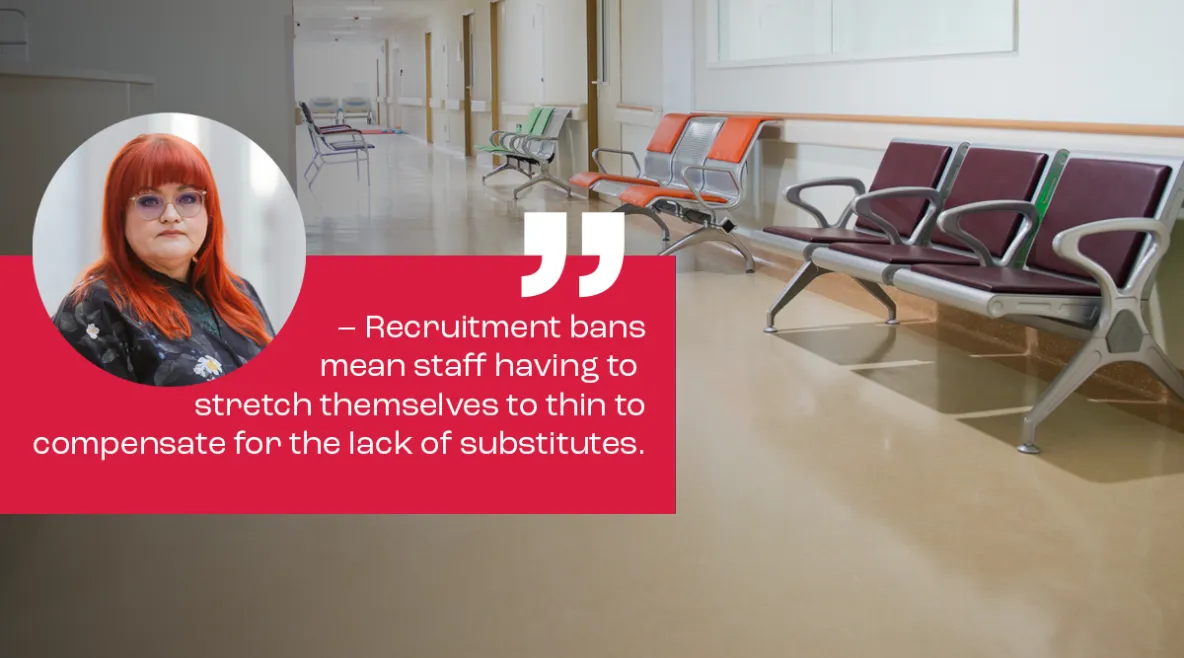
– In practice, recruitment bans mean staff having to stretch themselves thin to compensate for the lack of substitutes. The shortage of nurses has not gone away and is still a very real and serious problem that threatens the functioning of social welfare and healthcare services, says President of Tehy Millariikka Rytkönen.
Rytkönen turns her attention to decision-makers.
– Public sector employees have to shoulder the weight of heavy cost-cutting pressures from the central government. Therefore, I would particularly like to ask Prime Minister Petteri Orpo and Minister of Finance Riikka Purra if this is what you want – longer patient queues and poorer services.
There is still a significant shortage of registered nurses and practical nurses
Similarly to previous years, the most pressing shortages in the summer will be registered nurses and practical nurses. A total of 63% of the respondents reported a shortage of registered nurses and 43% reported a shortage of practical nurses.
Staff shortages appear to have decreased slightly from last year. Rather than resulting from an improvement in the staffing situation, however, this is due to cost-cutting measures and restrictions on recruitment in the wellbeing services counties. In practice, this means that needs are being left unfulfilled.
– Uncertainty about your own job situation, a fear of dismissals and downsizing, and prolonged cooperation negotiations undermine the workplace atmosphere and industrial peace. At the same time, employees are forced to be flexible with regard to their shifts and duties, which further increases their workload, says Tehy Career Specialist Tiina Cederberg, who carried out the survey.
A total of 40% of union representatives working in wellbeing services counties said that activities will be paused or scaled back for 5–6 weeks during the summer. These reductions will particularly affect outpatient clinics, surgery departments, maternity and child health clinics, mental health services, dental care and nurses’ appointments.
– However, our survey suggests that the majority of staff in the social welfare and healthcare sector will be able to take their summer holidays as usual. This is of course a good thing, Cederberg says.
Heavy workloads are also felt in the private sector
In private social welfare and healthcare services, the staffing situation was in many places perceived to be slightly more stable than in the wellbeing services counties. Summertime substitute arrangements and cost pressures also pose challenges in the private sector, particularly in round-the-clock services and services for the elderly.
In the private sector, the biggest shortages are registered nurses (41%) and practical nurses (41%). The situation is unchanged compared to the summer of 2025.
As the private sector is better able to adjust its activities than the public sector, it will not scale back its activities as much.
Staffing challenges in early childhood education continue
Summertime personnel arrangements in early childhood education remain difficult, particularly in large cities. The availability of substitutes varies from region to region, and the sufficient availability of staff is raising concern.
The most common reason for recruitment problems is a shortage of trained substitutes (44%). Other reasons include a recruitment ban (30%) and a substitute’s salary not being attractive enough (22%). Compared to the summer of 2025, there will be more recruitment bans in place this summer (17% in the 2025 survey).
– The higher workload will be reflected in the daily work of employees as increased difficulty in managing group sizes and insufficient staff, Tiina Cederberg says.
A total of 137 Tehy union representatives responded to the 2026 summertime employment survey. Of the respondents, 40 represented public social welfare and healthcare services (wellbeing services counties), 68 represented private social welfare and healthcare services and 29 represented early childhood education. The survey was open for responses from 20 April to 10 May 2026.
Tehy has collected information on personnel arrangements in health care, social welfare and early childhood education since 1991. In the survey, summertime refers to the period from 1 May to 31 August 2026.
Enquiries:
Tehy Career Specialist Tiina Cederberg, tel. +358 44 322 0992, [email protected]