
Tehy's proposal is a response to the education reform bill prepared by Prime Minister Petteri Orpo's (National Coalition Party) government, which is removing the possibility to complete nurse, paramedic and midwife qualifications as a double degree and at the same time extending midwives’ training without raising the level of education.
The aim of the bill is to reduce the need to obtain several higher education degrees of the same level. Under the proposal, paramedic training, midwife training and public health nurse training would be based on separate regulations that would need to be completed in addition to nurse training.
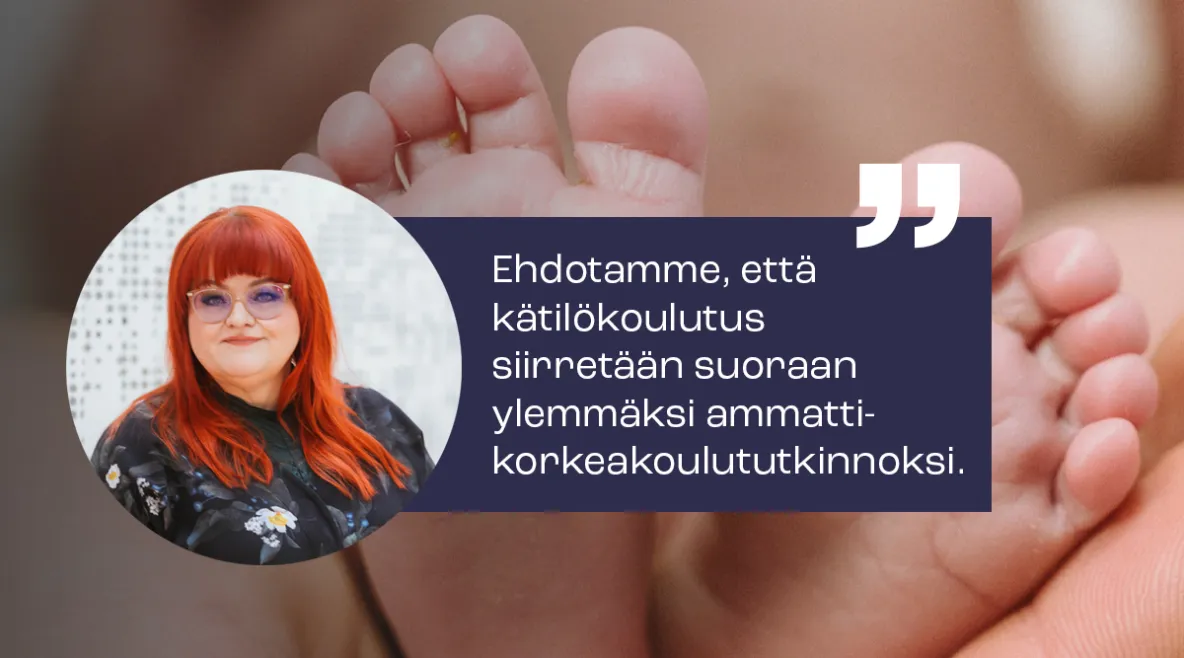
– The proposal would extend midwife training to five years, without raising the education level of midwives. We propose that midwife education be changed directly to a higher education degree from a university of applied sciences, says Millariikka Rytkönen, President of Tehy.
Rytkönen points out that midwifery is an internationally recognised autonomous profession that requires the ability to act as an independent decision-maker, define one's competence and manage care processes. In many countries part of the World Health Organisation (WHO) and in several European countries, midwife education is already a master's level qualification or includes elements of a higher degree. International research shows that master's level education prepares midwives for the demanding specialist, assessment, research and development duties that are at the heart of modern midwifery.
Tehy reminds legislators that the reform of midwife education must take into account the scope and high level of education required for the profession, as well as the requirements of the Professional Qualifications Directive. Therefore, Tehy proposes that midwife education be reformed into a higher education degree of at least 120 credits, from a university of applied sciences (YAMK).
Tehy also proposes to add midwife education to the Finnish National Framework for Qualifications and other extensive competence modules (FiNQF). This will ensure that the high level of education is recognised and acknowledged.
Finnish students training to become public health nurses, paramedics or midwives train for the degrees at the same time, and will also gain a nursing degree. With regard to midwifery, however, the current training does not meet the requirements of the European Union's Professional Qualifications Directive. According to the Professional Qualifications Directive, students should first complete nurse training and then train as midwives. Until now, the double degree training of midwives and nurses in Finland has not met the directive's requirement for the duration of midwife training following a completed nursing education. It has not been possible to have a midwife training completed in Finland be automatically recognised in other European Union countries.
Tehy has long called for midwife training to be developed to meet the requirements of the directive. In line with the Professional Qualifications Directive, the union finds it important that midwives first train as nurses.
On the basis of the Professional Qualifications Directive, the government’s law reform proposes that a person qualifying as a midwife must, in the future, first complete a nursing degree of 210 study credits (target completion time 3.5 years), followed by 18 months or 3,000 hours (about 1.5 years) of midwife training. Tehy believes that the 3,000 hours of study cannot be completed in 1.5 years.
In the government proposal, the scope of midwife education is not described in terms of credits. Tehy believes that midwife education – just like paramedic and public health nurse training – should be defined in terms of study credits, similar to other higher education studies, because credits are the best way to describe the true extent of training. A similar model is applied in Sweden, Iceland and Norway, for example.
Enquiries: Ira Hietanen-Tanskanen, Public Relations Manager, Tehy, tel. +358 45 1277 488, [email protected]