
The government has demanded that deficits be covered swiftly and that further savings be made – while at the same time, the wellbeing services counties have seen repeated cooperation negotiations, recruitment freezes and staff cuts.
The whole system is under strain due to a serious financing problem. The vast majority of counties have applied for an extension to cover their deficits, and three new counties have been placed under an assessment procedure by the government.
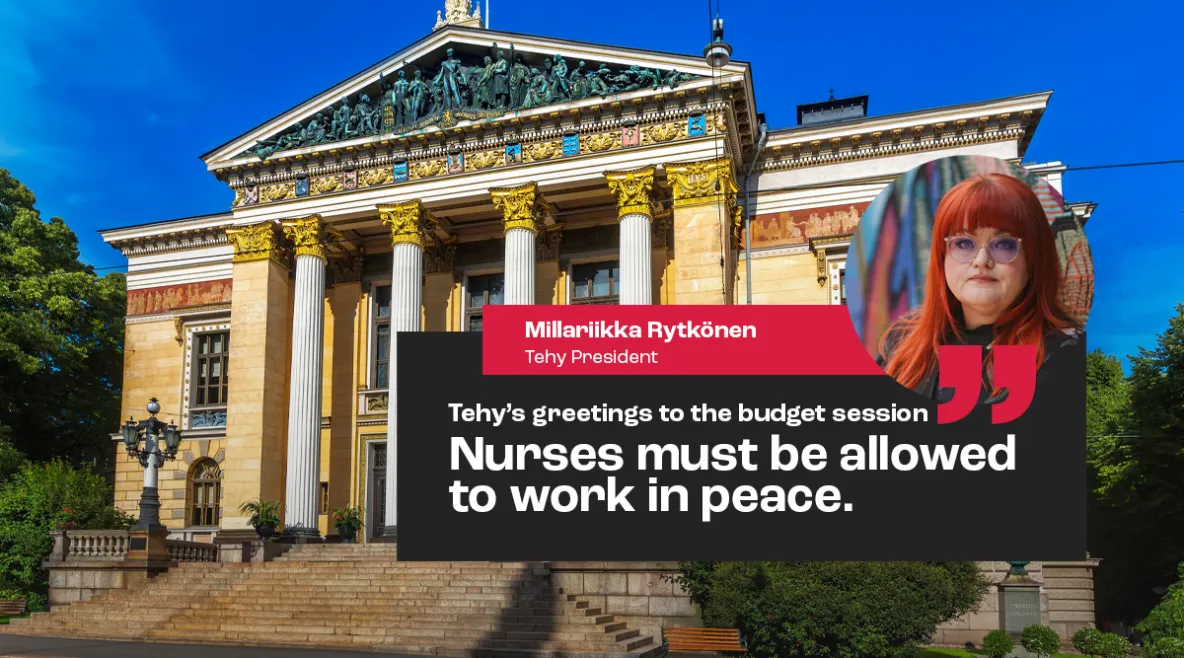
Tehy President Millariikka Rytkönen points out that functional healthcare and social services and a skilled workforce are an essential part of Finland's security of supply and comprehensive security. Money spent on healthcare and social welfare is also an investment in security.
– It's excellent that there is more talk of security and preparedness in Finland than there has been for decades. And that's why it's incomprehensible that you would simultaneously undermine the very system and the professionals on whom the whole of society relies in times of crisis. Money spent on healthcare and social welfare is also an investment in security of supply and safety, says Rytkönen.
An increase in funding does not equal a new investment in healthcare and social welfare
The government has justified its policy on the grounds that central government funding for the wellbeing services counties has increased. However, growth that is measured solely in euros does not indicate whether the services' operating conditions have been improved.
– The index adjustment itself is not a new investment in healthcare and social welfare. As prices, wage costs and people's needs for services rise, the euro amount of funding must also increase, if only to ensure that services remain at their current level. At the same time, further cuts have been demanded of the counties, says Anni Marttinen, Chief Economist at Tehy.
Tehy insists that funding for public services must take precedence over tax cuts. During the next government term, the funding model for the wellbeing services counties must be reformed so that the funding better reflects the counties' actual service needs and allows for long-term planning. Furthermore, the plans to reduce corporation tax must be abandoned.
– It is not possible to build better services, develop operations and retain employees in the sector if the target is constantly being moved. In the next electoral term, using the funding for healthcare and social welfare as a political pawn must stop, and a long-term, predictable outlook must be created for the wellbeing services counties, Rytkönen states.
Nurses must be allowed to work in peace
Prior to the government spending limits discussion in spring 2026, Tehy already called for halting the cuts to healthcare and social welfare, and reversing the reductions to corporation tax and the tax cuts for high earners.
The repeated cost-cutting and consultation negotiations are also taking their toll on employees. In an extensive survey published by Tehy in 2025, 64% of respondents working in the wellbeing services counties reported that their coping and wellbeing at work had deteriorated following the wellbeing services county reform. Only 28% believed that they would be able to carry on working in the sector until the end of their working lives.
– The nurses have done their part. They have been stretched thin by staff shortages, cost-cutting measures and constant organisational changes. This simply has to come to an end during the next electoral term. Nurses should think carefully about who to vote for in the parliamentary elections, says Rytkönen.
Enquiries:
Tehy President Millariikka Rytkönen. Requests for interviews through Special Advisor Mila Huovinen, tel. +358 40 054 0005, [email protected]
Tehy Chief Economist Anni Marttinen, tel. +358 954 227 170, [email protected]