
An agreement has been reached between the Local Government and County Employers KT and the primary employer organisations in the sector on a major pay reform. It applies not only to the SOTE agreement but also to the General Collective Agreement for the Welfare Sector (HYVTES).
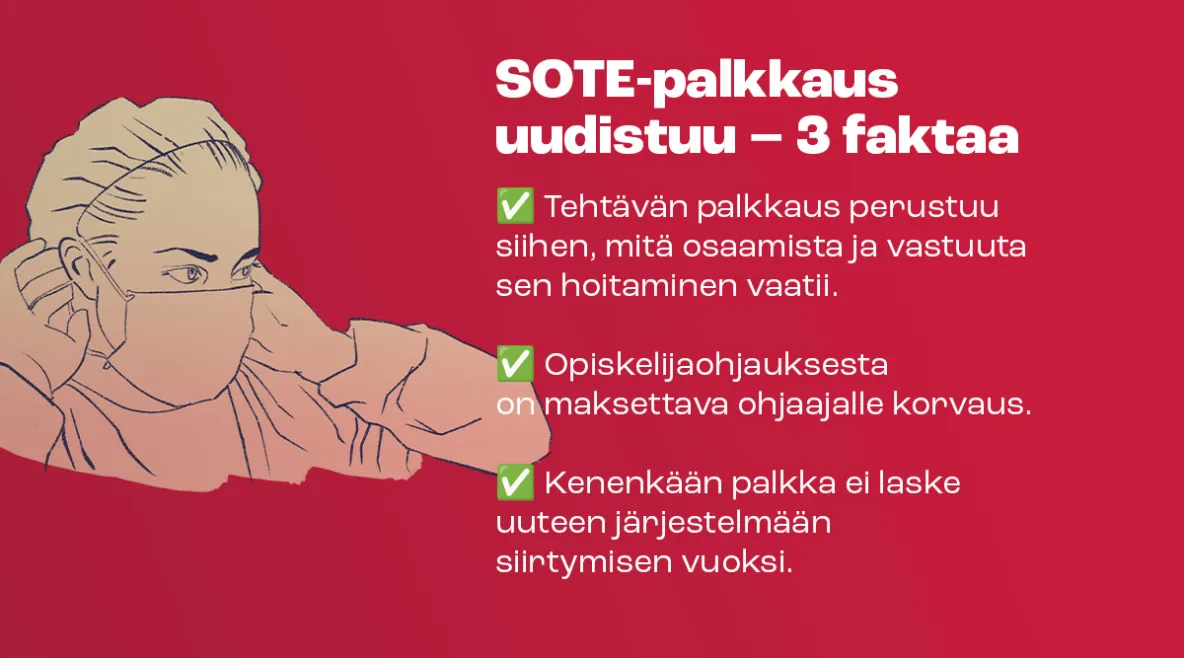
Under the new system, pay will be determined by placing different tasks at different tiers according to the level of skills and responsibility required to perform them. Specific criteria have been defined for each of the different pay groups.
- The new level pay system leaves behind the old way of assessing the demands of work in the health and social services sector. In the future, competence and responsibility will be better observed in salary determination, which will support salary increases in line with career development in the entire social and health care sector, says Jarkko Pehkonen, Director of Advocacy at Tehy.
The agreement also includes new mandatory bonuses. For example, going forward, a level pay bonus will be paid for acting as a supervisor to a student or a temporary supervisor to a social worker. The euro amounts of the bonuses will be negotiated locally.
- We are particularly pleased that the remuneration for student supervision has finally been made compulsory. Familiarising future colleagues is demanding work, and it is only right that it is reflected in the pay, says Millariikka Rytkönen, President of Tehy.
Actual salaries cannot decrease
A key principle for the entry into force of the reform is that no employee's actual salary will decrease as a result of the changeover. As a rule, the current job-specific salaries will become level pay salaries.
The transition to the new system will take place by 1 October 2026 at the latest. Local pay teams with union representatives and employers negotiating on local application instructions and level bonuses will be set up in workplaces in early 2026.
Tehy will monitor the preparations and communicate on the progress of the introduction of the new pay system.
Read more about the new level pay system: tehy.fi/sote-sopimus
Enquiries:
Jarkko Pehkonen, Director of Advocacy, tel. +358 40 531 5464, [email protected]